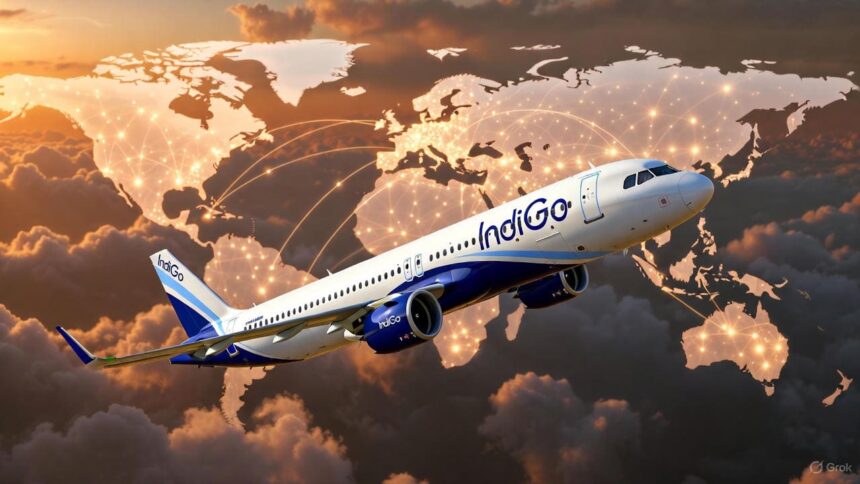
Imagine a world where a single airline, born in the turbulent skies of the mid-2000s, becomes not just the dominant force in one of the world’s fastest-growing markets, but a formidable global challenger. That world is now, and the airline is IndiGo. The year 2025 isn’t just another calendar page for InterGlobe Aviation’s crown jewel; it is the inflection point, the “year of growth and global expansion” where its ambitious blueprint transitions from boardroom presentations to runway reality.
While headlines often focus on quarterly profits or new plane orders, the real story of Indigo 2025 is a masterclass in strategic execution during global uncertainty. It’s a tale of carrying over 123 million passengers, navigating operational headwinds, and methodically stitching together a network that stretches from the historical lanes of Central Asia to the bustling capitals of Europe.
So, what exactly makes 2025 the defining chapter for IndiGo? Let’s peel back the layers, moving beyond the staggering passenger numbers to understand the strategy, the challenges, and the profound impact this low-cost behemoth is having on the very fabric of global aviation.
The Foundation: Unprecedented Scale in a Recovering Market
First, let’s ground ourselves in the scale we’re discussing. According to The Hindu Business Line, IndiGo entered 2025 with a clear, audacious forecast: to ferry over 123 million passengers. To put that in perspective, that’s roughly the entire population of Japan taking to the skies with one airline in a single year. Data from the Times of India confirms the airline was well on track, having already flown over 12 crore passengers (120 million) by December, despite a “difficult” final month marred by dense fog and operational disruptions.
This isn’t just growth; it’s acceleration. In the post-pandemic scramble, IndiGo 2025 didn’t just recover its pre-COVID volume—it exploded past it. Its market share in India hovers at a staggering over 60%, a level of domestic dominance that gives it unparalleled economies of scale, pricing power, and network density. This domestic fortress provides the cash flow and the passenger feed that make its international expansion strategy possible. Every flight from Jaipur to Delhi isn’t just serving that route; it’s potentially feeding a passenger onto a new flight from Delhi to Nairobi or Istanbul.



The Dual Engines: Domination at Home and Aggression Abroad
IndiGo’s 2025 strategy is powered by a dual-engine approach, and both are firing in perfect sync.
Engine 1: Deepening Domestic Roots
Even as it looks outward, IndiGo isn’t neglecting its home turf. The airline continues to add frequencies on “bread and butter” routes while also pioneering connections to India’s Tier 2 and Tier 3 cities. This ultra-low-cost carrier model, with its relentless focus on on-time performance, cost efficiency, and high aircraft utilization, remains impregnable. The sheer volume allows it to negotiate better rates on everything from fuel to ground handling, creating a virtuous cycle that competitors struggle to match. This domestic network acts as a vast, intricate spiderweb, catching traffic from every corner of the subcontinent and channeling it to its international gateways.
Engine 2: The International Leap – More Than Just Tourist Flights
This is where the Indigo 2025 growth story gets truly exciting. As reported by Zee Business, the airline has explicitly marked 2025 for global expansion. But this isn’t a haphazard splash onto random global routes. It’s a calculated, multi-pronged assault.
- Westward Ho with the A321XLR: The game-changer is the imminent arrival of the Airbus A321XLR (Extra Long Range). This aircraft is the key that unlocks a specific strategic map: connecting secondary Indian cities directly to Europe and deeper Asian destinations. Think Lucknow to London, or Ahmedabad to Athens, without the hassle of connecting through crowded mega-hubs. This strategy, often called “point-to-point long-haul,” allows IndiGo to tap into direct, high-demand traffic flows, bypassing traditional Gulf and European hub carriers.
- Capturing the Diaspora and Business Traffic: IndiGo is smartly targeting not just leisure tourists but the massive Indian diaspora and growing business travel segment. New and expanded routes to Central Asia (like Baku, Almaty), Africa (Nairobi, Lagos), and Southeast Asia are designed to serve these specific demographics, offering them direct, affordable connections.
- The Codeshare & Partnership Play: Recognizing that it can’t fly everywhere, IndiGo is rapidly building a web of strategic airline partnerships. Its codeshare with Turkish Airlines is a prime example, granting its passengers seamless, single-ticket access to scores of destinations across Europe, the Americas, and Africa via Istanbul. More such partnerships are likely in the works, effectively extending its network without adding its own metal.
Navigating Turbulence: The Challenges Behind the Glowing Headlines
No flight path is without turbulence, and IndiGo’s ambitious 2025 operational roadmap faced significant tests. The Times of India article hints at this with its mention of a “difficult December.” The challenges are multifaceted:
- Supply Chain & Aircraft Groundings: The global aviation industry is still reeling from supply chain bottlenecks for spare parts, particularly Pratt & Whitney engines that power a significant portion of IndiGo’s A320neo fleet. This has led to a number of aircraft being temporarily grounded, putting pressure on capacity at a time of soaring demand.
- Infrastructure Strain: India’s aviation infrastructure, despite improvements, is struggling to keep pace with this explosive growth. Congested airports, especially in Delhi and Mumbai, and air traffic control limitations can lead to delays, impacting the airline’s famed on-time performance.
- Geopolitical and Cost Pressures: Fluctuating oil prices and global geopolitical instability add a layer of financial uncertainty. For an airline that runs on razor-thin margins, effective fuel hedging and cost management are continuous, high-stakes battles.
What sets IndiGo apart is its proactive management of these crises. It has been aggressively leasing aircraft to mitigate grounding issues and is constantly working with airports to secure better slots and infrastructure. This operational resilience is a key, often understated, part of its success formula.
The Ripple Effect: What IndiGo 2025 Means for Everyone
The implications of IndiGo’s 2025 surge extend far beyond its own balance sheet.
- For the Indian Passenger: It means more choices, more direct connections, and sustained competitive pressure that keeps fares in check. The dream of direct, affordable international travel from one’s hometown is inching closer to reality.
- For the Global Aviation Order: Traditional full-service carriers and Gulf hubs are watching closely. IndiGo is no longer just a domestic worry; it’s a potent low-cost long-haul competitor that could reshape traffic flows on key Europe-India and Asia-India corridors. It is forcing incumbent players to re-evaluate their pricing and network strategies.
- For India’s Economy: As a critical piece of national infrastructure, IndiGo’s expansion boosts tourism, trade, and business connectivity. Its goal to enhance international connectivity from India aligns perfectly with the country’s ambition to become a global economic powerhouse and a major aviation nexus.
Conclusion: Not Just an Airline, but an Aviation Ecosystem
As we look at the Indigo 2025 passenger traffic forecast becoming a reality, it’s clear that IndiGo is evolving. It is transitioning from being merely India’s largest airline to becoming a central node in the global aviation network. The year 2025 represents the critical take-off phase for this transformation.
The journey ahead will require deft navigation of supply chain woes, infrastructure constraints, and fierce global competition. Yet, IndiGo has demonstrated a unique blend of operational discipline, strategic clarity, and an almost intuitive understanding of its home market. It has built a model that is scalable, adaptable, and relentlessly customer-focused.
In essence, IndiGo in 2025 is not just selling airplane seats; it is selling accessibility, knitting together a vast and diverse nation while building bridges to the world. It is writing a new playbook for how a low-cost carrier can achieve global scale and influence. As its new Airbus XLRs prepare to touch down, the message to the world is clear: the Indian aviation giant has arrived on the long-haul stage, and it’s here to stay. The skies, quite literally, are no longer the limit.
Read More: The Manus Deal: How a Tiny AI Startup Became a Geopolitical Flashpoint and Meta’s Biggest Bet