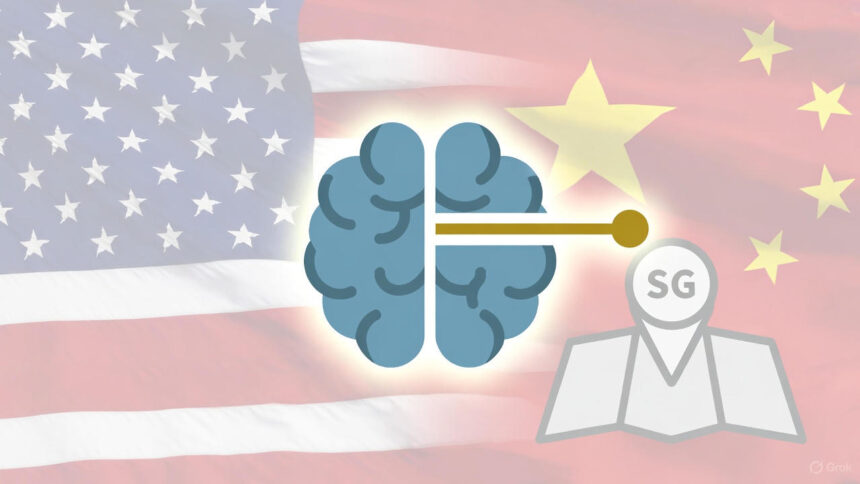
In the high-stakes world of artificial intelligence, the biggest moves are often the ones no one sees coming. In late December 2025, the tech world was jolted by an announcement that seemed to rewrite the rulebook: Meta, the Silicon Valley titan behind Facebook and Instagram, announced its acquisition of Manus, a relatively obscure Singapore-headquartered AI agent firm with deep Chinese roots. This wasn’t just another corporate merger. As reports from CNBC, Reuters, and The Hindu detailed, the deal instantly became a lens focusing the intense heat of the U.S.-China tech cold war, a bold strategic gambit for Meta, and a case study in the new, borderless reality of AI innovation. Let’s unpack the fascinating story of Manus AI, the Meta Manus acquisition, and its far-reaching implications.
What is Manus? Unpacking the AI Agent Specialist
Before understanding why this deal matters, we need to understand what Manus actually does. Described in reports as a “Singapore AI agent firm,” Manus wasn’t a consumer-facing app or a large language model like ChatGPT. Its expertise lay in building sophisticated autonomous AI agents—software entities that can perform complex, multi-step tasks online with minimal human intervention.
Think beyond a simple chatbot that answers questions. A Manus AI agent could be tasked with “plan a complete seven-day business trip to Tokyo, finding flights that optimize for cost and layover time, booking hotels near the meeting venues, reserving restaurants based on my dietary preferences, and scheduling all transportation.” The agent would then navigate various websites, interact with forms, synthesize information, and execute the plan. This requires advanced reasoning, planning, and web navigation capabilities—areas where even the most advanced LLMs can struggle.
Founded by Chinese AI experts but incorporated in Singapore, a common maneuver for tech startups navigating geopolitical tensions, Manus operated under the radar. However, its technology, often linked to its purported internal codename “MonicaAI,” was considered cutting-edge. According to The Hindu’s reporting, Meta was particularly impressed by Manus’s work in “advanced AI features” for task automation and workflow integration. In essence, Manus built the “hands and feet” for AI’s “brain,” allowing it to act meaningfully in the digital world.
The Strategic Imperative: Why Meta Went All-In on Manus
Mark Zuckerberg has made it unequivocally clear that building leading artificial general intelligence (AGI) and making it accessible is Meta’s central goal. But in the AI race against rivals like OpenAI, Google, and Anthropic, having a powerful LLM (like Meta’s Llama series) is only half the battle. The true value, and the next frontier, is usability and real-world utility.
This is the core of Meta’s AI strategy. They don’t just want a chatbot in your sidebar; they envision AI assistants that can manage your business, create content, control smart homes, and operate across Meta’s family of apps (Facebook, Instagram, WhatsApp, Quest). The acquisition of Manus, as noted by Reuters, is explicitly to “boost advanced AI features.” It’s a force multiplier.
By integrating Manus’s agentic AI technology, Meta can leapfrog from offering conversational AI to providing proactive, capable AI employees. Imagine an AI that doesn’t just suggest you book a flight but actually books it for you, navigating the captchas and payment portals. Or an AI that doesn’t just advise on ad campaigns but sets them up, monitors performance, and reallocates budget in real time. This shift from assistant to agent is pivotal. Manus provides the crucial “how” to Meta’s “what.”



Navigating the Geopolitical Minefield: The “China Butterfly Effect”
The most explosive aspect of this deal, highlighted brilliantly in the CNBC report’s headline “China Butterfly Effect,” is its geopolitical entanglement. While Manus is a Singaporean entity, its technical talent and foundational research are widely reported to be Chinese. This immediately triggers a web of regulatory and national security concerns.
The U.S.-China tech war has seen strict controls on the transfer of sensitive technologies, particularly semiconductors and AI. The Committee on Foreign Investment in the United States (CFIUS) scrutinizes deals with potential national security implications. While this is a Meta (U.S.) buying a Singaporean company, the deep Chinese ties invite immense scrutiny. Reuters pointedly noted the deal’s complexity, given the “heightened U.S. scrutiny of Chinese tech.”
The “butterfly effect” refers to the small, initial cause (the acquisition of a startup) leading to large, unforeseen consequences. Potential ripple effects include:
- Regulatory Blockage: Could CFIUS or other bodies move to block or impose severe conditions on the deal?
- Retaliatory Measures: Could China, sensitive about its AI talent and IP being absorbed by a U.S. firm, impose its own restrictions or launch investigations?
- Market Fragmentation: Does this deal accelerate the decoupling of U.S. and Chinese AI ecosystems, or paradoxically, prove that top-tier AI talent and innovation cannot be fully contained by borders?
Meta’s structure, with Manus likely remaining a Singapore-based subsidiary, is a carefully crafted corporate shield. But as experts cited in these reports suggest, the political and security questions are unavoidable. The deal tests the resilience of global tech supply chains and the very idea of “neutral” innovation hubs like Singapore.
Case in Point: The “MonicaAI” Enigma and Competitive Edge
Diving into a specific use case helps illustrate Manus’s value. References to “MonicaAI” (from the CNBC URL) suggest this might be the internal or flagship agent platform developed by Manus. A platform like MonicaAI would specialize in intelligent process automation that goes far beyond basic RPA (Robotic Process Automation).
Consider a digital marketing manager. Their workflow involves data analysis from Meta Ads Manager, crafting creative briefs, coordinating with designers, A/B testing copy, and reporting. A MonicaAI-powered agent, integrated into Meta’s suite, could theoretically:
- Analyze historical campaign data to predict high-performing demographics.
- Draft initial ad creatives using generative AI.
- Submit them to a human designer for refinement via a connected project management tool.
- Launch a controlled multivariate test across Instagram and Facebook.
- Optimize spending daily based on real-time conversion data.
- Compile a weekly performance report.
This level of end-to-end workflow automation represents a massive productivity leap. For Meta, offering this natively to its millions of business users locks them deeper into its ecosystem and creates a formidable moat against competitors like Google and Microsoft in the enterprise AI solutions space. It transforms Meta from a social media company to an essential AI-powered business operations platform.
Expert Insights: What the Analysts Are Saying
While the deal is fresh, analysts weighing in across these publications identify several critical insights:
- Talent over Product: Many see this as primarily an acqui-hire. The small but exceptionally talented team at Manus, with its expertise in AI reasoning and action, is worth more than any current product. As one expert told The Hindu, it’s about “securing a niche group of researchers and engineers who can push the boundaries of what AI agents can do.”
- The Agent-First Future: The consensus is that the post LLM era will be defined by reliable, safe, and capable AI agents. Manus gives Meta a potentially decisive head start in making this future a tangible product.
- Regulatory Peril: All reports underscore the high regulatory risk. An analyst quoted by Reuters called it a “high-reward, but exceptionally high-risk move” that will be a “litmus test for U.S.-China tech relations in the AI age.”
The Road Ahead: Integration Challenges and the Future of AI
Beyond the headlines, the real work begins. Technical integration of Manus’s specialized agent frameworks with Meta’s massive AI infrastructure and diverse app family is a monumental challenge. There are also profound ethical and safety considerations. Autonomous agents that can act in the digital world pose risks: they could make costly errors, be manipulated for fraud, or act in unintended ways. Building robust safety guardrails and verification systems is paramount.
Furthermore, the success of this deal will define the future of human-AI collaboration. Will these agents be transparent tools, or black boxes making decisions on our behalf? Meta will have to navigate not just code, but profound questions of trust and control.
Conclusion: A Defining Moment in the AI Era
The acquisition of Manus by Meta is far more than a business transaction. It is a strategic masterstroke that reveals the next battleground in AI: action over analysis. It is a geopolitical lightning rod that highlights the inextricable links and tensions between U.S. capital and Chinese AI talent. And it is a bold bet on a future where AI doesn’t just talk, but does.
Whether this deal ultimately faces a regulatory blockade or sails through, its announcement has already altered the landscape. It has signaled to the industry that the race is on to build useful, agentic AI. It has reminded governments that innovation flows in complex ways. And it has shown that in the quest for AGI, the most valuable keys might not lie in Silicon Valley garages, but in global, distributed teams like Manus, whose deep expertise in making AI act has suddenly made them one of the most important players on the board. The story of Manus is just beginning, and its chapters will be written at the fraught and fascinating intersection of technology, strategy, and global power.
Read more: Mexico Tariff Strike on India: A Deep Dive into Trade Tensions and Global Politics