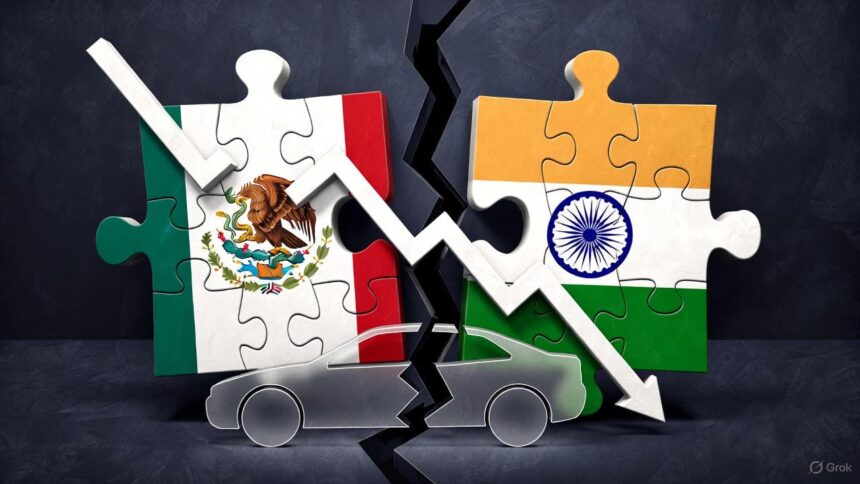
Mexico Tariff Strike: In a move that has sent shockwaves through international trade circles, Mexico has announced sweeping tariffs of up to 50% on a wide range of Indian goods, set to take effect on January 1, 2026. This decision, part of a broader policy targeting nations without a Free Trade Agreement (FTA) with Mexico, places India squarely in the crosshairs of a new protectionist wave. The policy, which covers over 1,460 products, is a strategic gambit by President Claudia Sheinbaum’s government, driven by a complex mix of domestic industrial policy, global geopolitical alignment, and economic self-interest. For India, the stakes are enormous, with a significant portion of its $8.9 billion annual exports to Mexico suddenly facing a precarious future.
At its core, this is more than a bilateral trade spat; it is a reflection of the shifting tectonic plates of global commerce. While the tariffs nominally apply to many Asian nations, including China, South Korea, and Thailand, the impact on India is particularly acute. The Indian automobile industry, which has built Mexico into its third-largest export market, now stares at an existential threat, with $1 billion in annual vehicle exports hanging by a thread. This article will unpack the layers behind Mexico’s decision, analyze the profound impact on key Indian sectors, and explore the potential diplomatic and strategic pathways forward in a world where trade is increasingly weaponized.
Why Mexico Pulled the Trigger: The Four-Pronged Strategy
Mexico’s decision is not an isolated act but a calculated move with multiple, interlocking objectives. Understanding these motives is key to grasping the potential longevity and impact of the new tariff regime.
- Containing the Chinese Flood: The primary and most publicly stated target is China. Mexico is grappling with a massive and growing trade deficit with China, exceeding $100 billion. Cheap Chinese imports have inundated markets for steel, auto parts, textiles, and electronics, undercutting Mexican manufacturers. Furthermore, there is significant concern about Chinese companies using Mexico as a “backdoor” to bypass U.S. tariffs and access the North American market. By imposing high tariffs on all non-FTA countries, Mexico aims to erect a barrier against this influx, with China as the main target.
- Pre-emptive Alignment with the United States: Geopolitics plays a crucial role. The United States-Mexico-Canada Agreement (USMCA), the cornerstone of North American trade, is due for review in 2026. Both the outgoing and incoming U.S. administrations have repeatedly warned Mexico against becoming a conduit for Chinese goods. Analysts like Oscar Ocampo, director of economic development at the Mexican Institute for Competitiveness, argue this tariff move is a direct political signal to Washington. By demonstrating a willingness to crack down on Asian imports, Mexico is seeking to position itself as a cooperative ally, hoping to secure favorable terms in the USMCA review and potentially gain exemptions from existing U.S. tariffs on its own steel and aluminum.
- Shielding Domestic Industry and Jobs: Domestically, President Sheinbaum and the ruling Morena party have framed the tariffs as an essential defense of Mexican industry and workers. The narrative is one of protecting local factories from “unfair” foreign competition. Industries like steel, textiles, and certain auto parts stand to gain a significant price advantage, which the government hopes will spur local production and job creation.
- A Fiscal Windfall: The policy also has a straightforward revenue motive. The Mexican government estimates the new tariffs will generate approximately 70 billion pesos (around $3.75 billion USD) in annual additional revenue. This substantial sum provides a strong fiscal incentive to maintain the policy, even in the face of potential consumer price inflation.
India in the Crossfire: A Sector-by-Sector Breakdown of the Damage
While China is the intended target, India emerges as the most significant collateral damage. The lack of a Free Trade Agreement between India and Mexico leaves Indian exporters uniquely vulnerable. The impact is not uniform; it will devastate some sectors while leaving others with a fighting chance.
| Sector | Annual Export Value to Mexico | New Tariff Rate | Key Impact & Challenges |
|---|---|---|---|
| Passenger Vehicles | $800 million – $1 billion | 50% (up from 20%) | Existential threat. Makes exports largely unviable. Forces a rethink of the entire Mexico strategy. |
| Auto Parts & Components | $600 – $700 million | 25% – 50% | Severe blow. Renders many mass-market components uncompetitive against local or FTA-sourced parts. |
| Iron & Steel | ~$900 million | 35% – 40% | Major disruption. Deals a serious blow to major players like Tata Steel, jeopardizing a key export market. |
| Textiles, Apparel & Footwear | $500 – $600 million | 30% – 35% | High vulnerability. Likely to wipe out mass-market exports; only high-end, niche products may survive. |
| Organic Chemicals & Pharmaceuticals | ~$400 million | 15% – 30% | Existential threat. Makes exports largely unviable. Forces a rethink of entire Mexico strategy. |
The Automobile Catastrophe
The automobile sector represents the crown jewel of India-Mexico trade and now faces the most severe crisis. Major manufacturers like Skoda Auto Volkswagen (accounting for nearly 50% of exports), Hyundai, Nissan, and Suzuki (Maruti) have built a robust export pipeline to Mexico, shipping compact, fuel-efficient cars designed specifically for the Mexican market. The industry body, the Society of Indian Automobile Manufacturers (SIAM), had pleaded with the Indian government to intervene, arguing that “Indian-origin vehicles are not a threat to Mexican local industry,” as they cater to a different segment than the vehicles Mexico produces for North America. Their appeals fell on deaf ears.
The jump from a 20% to a 50% tariff is prohibitive. It will effectively price Indian-made cars out of the market. As Piyush Arora of Skoda Auto Volkswagen noted, Mexico had been a consistently important export market. Now, companies are forced into a painful dilemma: absorb the massive cost (eroding all profitability), pass it on to Mexican consumers (killing demand), or cease exports altogether. This not only threatens a billion-dollar revenue stream but also undermines India’s strategic positioning as a global automotive export hub.
Mexico Tariff Strike: The Ripple Effect on Supporting Industries
The pain extends beyond finished cars. The auto components sector, a backbone of India’s manufacturing, faces tariffs of 25-50%. This will disrupt integrated supply chains that Mexican and international automakers based in Mexico have come to rely on. Similarly, Indian steel, which found a steady market in Mexico’s construction and manufacturing, now become 35-40% more expensive, ceding ground to domestic Mexican producers or suppliers from FTA countries like the United States.
The Geopolitical Chessboard: Winners, Losers, and Long-Term Implications
This tariff move creates a complex web of economic consequences, with clear winners and losers that extend beyond the two nations directly involved.
The Winners:
- Mexican Domestic Industry: Sectors like steel, basic textiles, and low-to-mid tier auto parts receive immediate protection. They gain a price advantage that could lead to market share expansion and, potentially, new investment.
- The Mexican Treasury: An estimated $3.75 billion annual revenue boost is a powerful incentive to maintain the policy.
- The United States: Achieves a key geopolitical objective by pressuring an ally to align with its efforts to decouple supply chains from China and curb Chinese economic influence in North America.
The Losers:
- Indian Exporters: Bear the brunt of the policy. Automakers and steel producers face immediate, severe losses. Thousands of jobs in these export-oriented sectors in India are now at risk.
- Mexican Consumers and Manufacturers: Will face higher prices for a wide range of goods, from clothing and shoes to electronics and cars. Mexican manufacturers who rely on cheap, quality Indian inputs for their own production will see costs rise, hurting their competitiveness.
- Global Trade Stability: The move signals a continued retreat into protectionism and “friend-shoring,” where trade is dictated by political alliances rather than pure economic efficiency. It undermines the rules-based global trading system.
For India, this episode is a stark wake-up call. It highlights the vulnerability of being outside modern, comprehensive trade blocs. Prime Minister Narendra Modi’s vision of “Make in India for the World” suffers a direct hit, as one of its success stories is abruptly jeopardized not by market forces but by political fiat.
Pathways Forward: Diplomacy, Deals, and Diversification
In response to the crisis, the Indian government has elevated the matter to an urgent diplomatic priority. The path forward is narrow but clear:
- Fast-Track a Trade Agreement: India’s most powerful countermove is to aggressively pursue a bilateral Free Trade Agreement (FTA) or a Partial Scope Agreement (PSA) with Mexico. Negotiations would be complex, but focusing initially on securing tariff exemptions for automobiles and steel could provide a lifeline. This is now India’s top diplomatic trade objective.
- Strategic Lobbying and Coalition-Building: India can work behind the scenes with other affected nations, such as South Korea and Thailand, to present a united front. Highlighting the negative consequences for Mexican consumers and downstream industries could build domestic pressure within Mexico for exemptions or a softening of the policy.
- Corporate Reinvention: Indian companies, particularly automakers, must consider radical strategic shifts. The most likely outcome is the relocation of final assembly to Mexico to serve the local market. This represents a loss of high-value manufacturing jobs for India but preserves market access. Alternatively, companies may be forced to abandon the Mexican market entirely and accelerate diversification to other regions.
Mexico Tariff Strike Conclusion: A Pivot Point in India-Mexico Relations
Mexico’s sweeping tariffs mark a pivotal moment in its economic and foreign policy, and a painful setback for India’s export ambitions. While aimed at China, the policy’s architecture has ensnared a friendly nation with which Mexico has built a thriving $9 billion trade relationship. The decision, born of domestic politics, fiscal need, and deference to U.S. pressure, exemplifies how trade is increasingly a tool of geopolitical strategy.
For India, the message is unambiguous: in a fragmented world, strategic autonomy in trade requires deep, institutionalized partnerships. Relying on goodwill and market logic is insufficient. The coming months will test India’s diplomatic agility as it races to secure a trade deal before the January 2026 deadline. The future of a billion dollars in annual exports and the credibility of India as a resilient trading partner, hangs in the balance. The outcome will not only define the India-Mexico relationship but also serve as a case study for how middle powers navigate the treacherous waters of 21st-century geoeconomics.
Read more: Vivo X300 Pro: A Deep Dive into India’s New Telephoto Photography Powerhouse